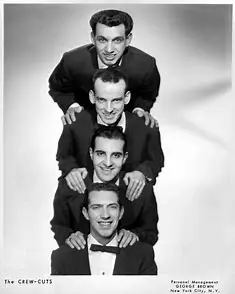
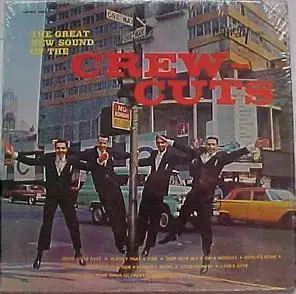
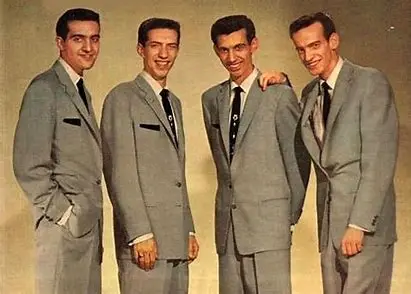
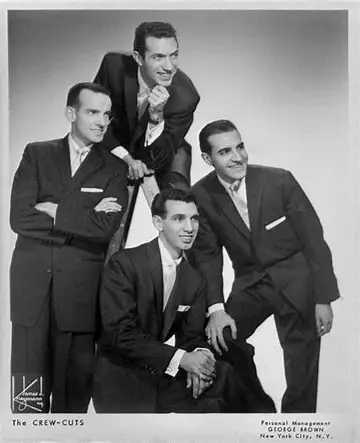
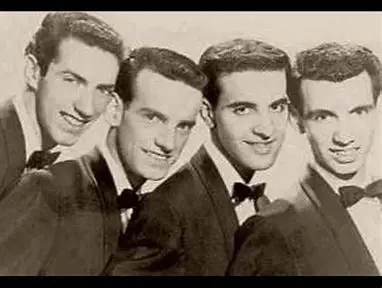
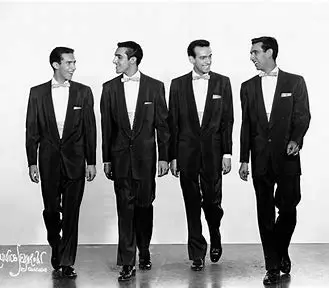
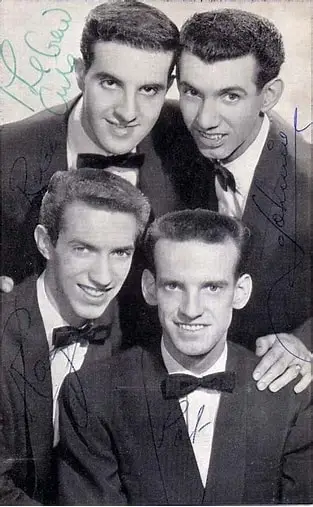
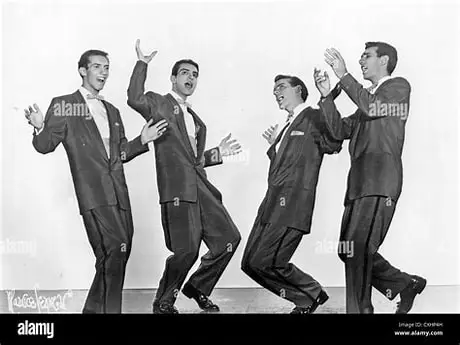

Group Name: The Crew Cuts
Formed: 1952 – Toronto, Ontario, Canada
Genres: Doo-Wop, Traditional Pop, Rock and Roll
Instruments: Vocals (vocal harmony group)
Years Active: 1952–1964
Labels: Mercury Records, RCA Victor, Checker Records
Early Life
The Crew Cuts were formed in Toronto, Canada, by four high school friends: Rudi Maugeri, John Perkins, Ray Perkins (John’s brother), and Pat Barrett. All members were classically trained singers with a flair for tight harmonies and a love of rhythm and blues. The group originally performed under the name The Four Tones, then changed to The Canadaires, and finally adopted the name The Crew Cuts—a nod to the popular short hairstyle of the 1950s, signifying their clean-cut, all-American image (even though they were Canadian).
They were discovered after winning a talent contest in Toronto and were soon signed by Mercury Records.
Career Highlights
The Crew Cuts rose to fame in the mid-1950s with a series of polished pop covers of rhythm and blues hits—bringing those songs to a broader, often whiter audience at a time when R&B records were still segregated on the radio.
Their biggest hit:
“Sh-Boom” (1954) – A cover of The Chords’ original R&B version, the Crew Cuts’ version reached #1 on the Billboard charts and became a cultural phenomenon.
Other major hits include:
“Earth Angel” (1955) – Another R&B-to-pop crossover, originally by The Penguins.
“Ko Ko Mo (I Love You So)”, “Gum Drop”, and “Angels in the Sky”
Though often criticized for sanitizing Black music for mainstream pop audiences, The Crew Cuts were instrumental in bringing R&B sounds into white suburban households—albeit with smoother harmonies and a polished finish.
Musical Career
The Crew Cuts specialized in a style that merged vocal group harmony, pop sensibility, and just a touch of early rock and roll energy. Their approach was characterized by:
Tight four-part harmonies
Crisp arrangements with a bounce
A polished, family-friendly aesthetic
They often recorded songs originally by Black artists, helping these tunes reach the pop charts even if the originals were marginalized.
While The Crew Cuts enjoyed substantial chart success between 1954 and 1956, their popularity faded with the rise of edgier rock ‘n’ roll acts like Elvis Presley, Little Richard, and Chuck Berry.
Later Years
By the late 1950s, The Crew Cuts’ star began to dim as rock and roll became louder, faster, and more rebellious. Their last charting single came in 1958, and by the early 1960s, the group had effectively disbanded.
Some members continued to perform individually or in small revival acts, and their songs occasionally resurfaced in nostalgic compilations and film soundtracks.
Cultural Impact
The Crew Cuts were a bridge group—one of several white vocal harmony acts (like The Four Lads, The Diamonds, and The Ames Brothers) who helped translate rhythm and blues into mainstream pop before rock and roll fully took over.
Their work, particularly “Sh-Boom,” remains a defining moment in the evolution of American pop music and one of the earliest songs to hint at the fusion that would soon become rock ‘n’ roll.
While viewed today with a more nuanced understanding of racial and cultural dynamics in music, The Crew Cuts remain part of the complex tapestry of 1950s pop and its journey from street corner harmonies to radio dominance.